I’ve Watched Teams Lose Direction for Years. AI Just Made It Faster
AI can expand the number of possible roads. Without a compass, it can also make teams pivot faster than they can orient.
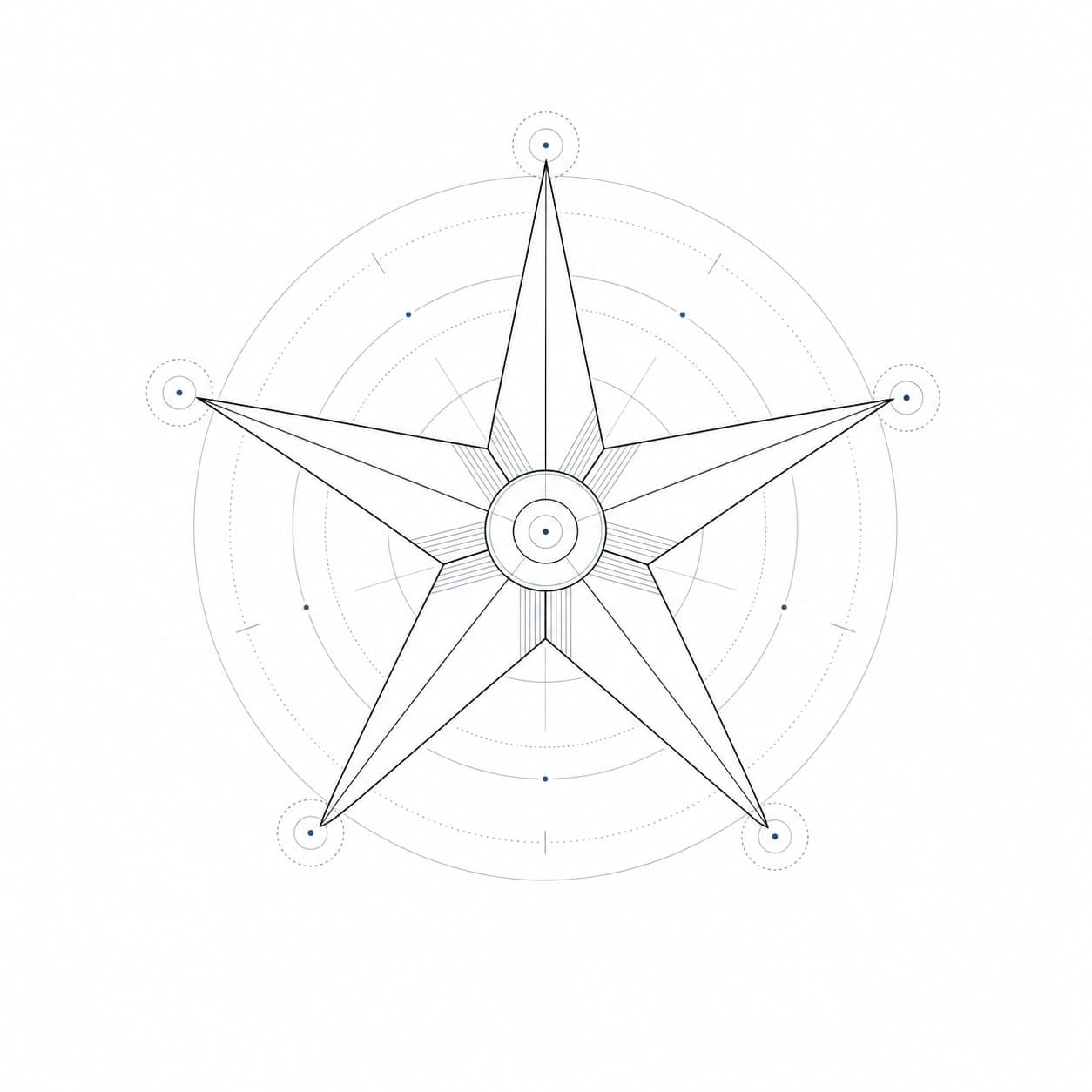
When more roads appear, you need a better compass. Not a faster one. I want to say something clearly before I go further: AI is one of the most powerful thinking tools I've encountered in years of working with teams. What follows is not an argument against using it.
It's an argument for knowing what you bring to the conversation when you do.
The email that said everything
A senior product manager at a large corporate sent a project update to a client. Formal email, multiple stakeholders in CC, sensitive moment in the project. The kind of message you review twice before sending. At the bottom, the client quoted something back:
"Please let me know if this message is warm enough, or
The email isn't really about a forgotten prompt. It's about a manager who outsourced his judgment to a tool — and the tool, as tools do, produced a plausible output with no knowledge of the client, the relationship, the history, or what that message actually needed to accomplish.
The tool had no compass. And in that moment, neither did the manager.
When one decision creates three problems
What happened next in that team is where the story gets interesting. The email incident shook the client's confidence — not catastrophically, but enough. The product manager, under pressure to rebuild trust, started using AI more intensively to drive decisions. Faster analysis. More options. Quicker responses.
Week one after the incident: AI recommended repositioning the product's core feature set based on a competitor analysis. The team pivoted. Week three: a new analysis suggested the pivot was too narrow. Broaden the scope. The team pivoted again. Week six: the data pointed toward a completely different user segment. The roadmap changed for the third time in six weeks.
The team had been working hard the entire time. The velocity was high. The ceremonies were running. The dashboard looked fine. At the retrospective, one of the developers said something quietly:
"I don't know what we're building anymore. And I'm not sure anyone does." Nobody challenged it.
Three problems. One broken compass.
I use this story as an anchor because it contains, in a single sequence of events, the three most common ways I've watched AI create directionless teams. The missing filter is the most visible. The product manager was using AI as a primary decision-making tool — not as a thinking partner within a direction he'd already set, but as the source of the direction itself. Every output became a potential new priority. Every analysis became a potential pivot.
AI is extraordinarily good at generating plausible directions. It is not designed to tell you which direction is yours. That requires context the tool doesn't have: your organization's history, your team's capacity, your clients' expectations, the decisions you made six months ago and why.
The erosion of trust is the second layer. The email incident didn't just embarrass the manager — it raised a question the team couldn't stop asking: how many of our decisions are actually his, and how many belong to the tool? When a leader's judgment becomes indistinguishable from an AI output, the team loses its anchor. They stop trusting the direction because they're no longer sure where it comes from.
The uniformity of speed is the third. AI makes pivots cheap to suggest. The problem is that pivots are not cheap to execute. Every time the team changed direction, they carried the cost: stopping, reorienting, rebuilding the context they'd developed for the previous direction. Three pivots in six weeks didn't mean three times the agility. It meant three times the disorientation.
The tool was fast. The team was exhausted. The compass was spinning.
More roads require a better compass, not a faster one
Here's what AI has genuinely changed: the number of available directions has multiplied. You can generate ten product concepts in an afternoon. Analyze a competitor in an hour. Draft a strategic roadmap before lunch. This is remarkable — and genuinely useful, in the right hands.
But more roads require more orientation, not less. Think of it this way: navigating a single road requires almost no compass work. You follow the road. Navigating a crossroads with ten options requires you to know which direction is north — so you can evaluate each option against where you're actually going.
AI has turned every strategic decision into a crossroads with ten options. If you arrive at that crossroads with a clear north — a model that tells you where you're going, what season your team is in, what you're willing to change and what stays fixed — AI becomes an extraordinary tool for exploring the best path within your direction.
If you arrive without that north, AI will offer you ten compelling directions. You will follow the most convincing one. Until the next analysis produces a more convincing one. A broken compass doesn't point nowhere. That would be easier to diagnose. A broken compass points somewhere convincing. Just not where you need to go.
What the manager needed before he opened the tool
The product manager in this story wasn't lazy or incompetent. He was genuinely trying to keep the team informed, responsive, ahead of the curve. What he was missing wasn't better AI prompts. It was a model that sat above the tool — a stable reference point he could return to before opening AI, and a filter for evaluating what came out of it.
That model needs to answer questions the tool cannot answer for you: Where are we going — and why this direction, at this moment? What type of work are we doing right now — and what does success look like in this season? What are we willing to change — and what stays fixed regardless of what the analysis suggests?
These aren't questions you answer once in a strategy document and forget. They're questions you return to regularly — individually and as a team — so that when AI produces a new direction, you have the orientation to evaluate it rather than simply follow it. The tool is powerful. The compass has to be yours.
One thing to do before your next AI session
Write down one sentence before you open the tool:
"The direction I'm already committed to is _______. I'm using AI to explore _______ within that direction." That sentence is the difference between AI as a thinking partner and AI as a compass. A thinking partner expands what's possible within a direction you've chosen.
A compass tells you where to go. Only one of those is your job. Have you seen this pattern — a team that lost direction because the tool became the compass?
Not sure which navigation mode fits your current season?
The Compass Navigation Diagnostic helps you identify the Primary and Secondary Vessels that best reflect the work you are navigating today.
Start the Compass Navigation Diagnostic